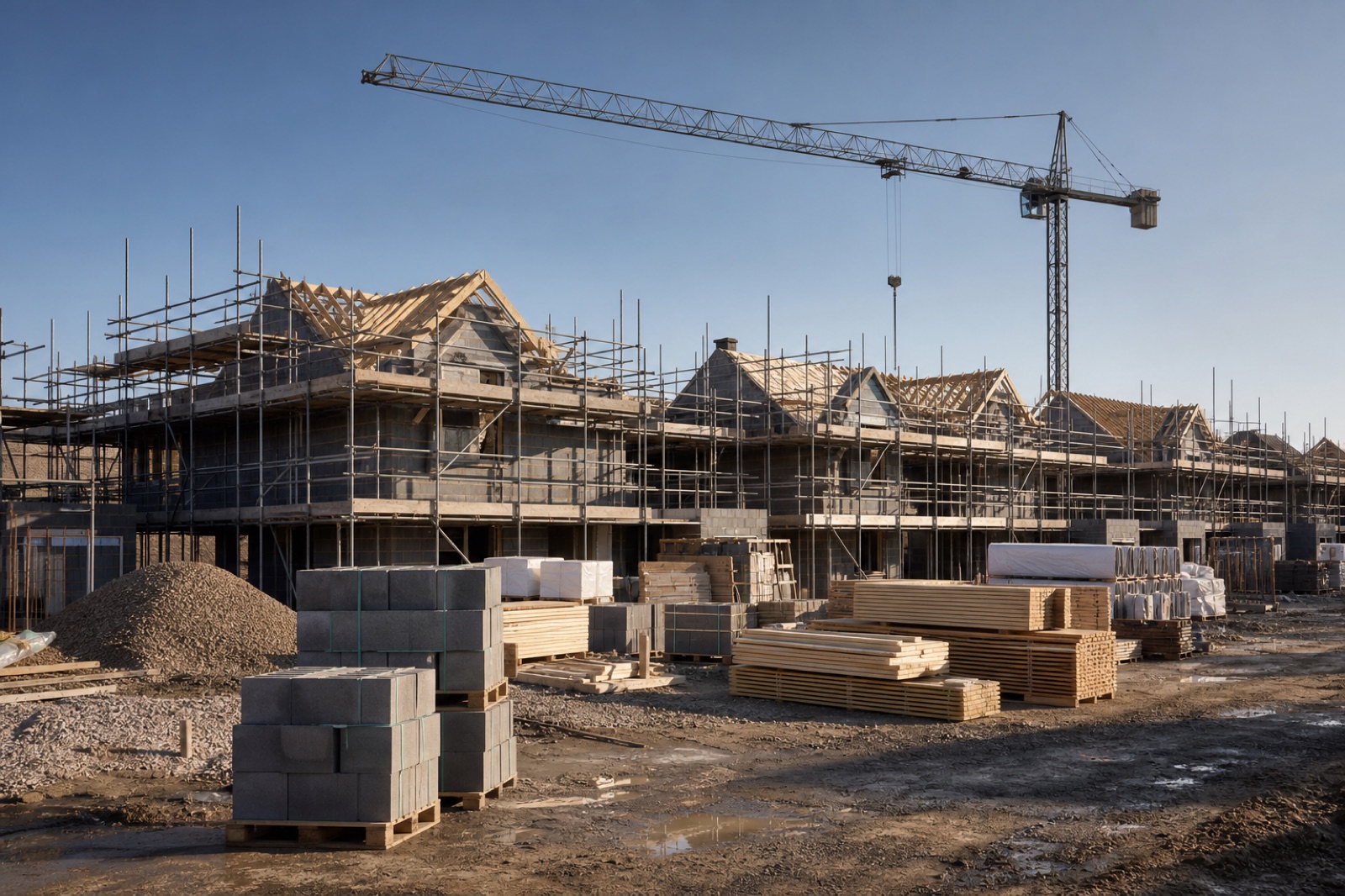
Property Development Finance
Development finance funds the purchase of land or an existing building and the construction costs of a ground-up development or major conversion. We arrange development finance for residential and mixed-use schemes, from single plots to multi-unit sites, with staged drawdowns against build cost.

What is development finance?
Development finance is a type of short-term property loan designed specifically for new-build, conversion or major refurbishment projects where the end value, the Gross Development Value (GDV), is materially higher than the current site value. Unlike a standard bridging loan, which is usually advanced in full on day one, development finance releases funds in staged drawdowns as the build progresses, with each drawdown verified by a monitoring surveyor against the build programme and cost schedule.
The loan is sized against GDV and against the total project cost, expressed as loan-to-cost (LTC). A typical development lender will advance up to around 65% of GDV or up to around 85% to 90% of total cost, whichever is lower, meaning the developer must contribute the balance from equity or subordinate funding. The land or existing property is bought with the opening tranche; subsequent tranches fund the construction as milestones are reached.
Development finance is unregulated lending. It is arranged for property developers, builders, investors and experienced borrowers on investment and commercial property or land. Because it is unregulated we arrange it directly, without referral to an FCA-authorised firm.
- Ground-up development: funding for new residential, commercial or mixed-use construction from foundation to completion
- Conversion finance: major conversions, commercial-to-residential, office-to-flats and similar change-of-use schemes with full planning consent
- HMO and multi-unit schemes: larger refurbishments creating multiple lettable units
- Staged drawdowns: funds released in tranches against the build programme, verified by a monitoring surveyor
- GDV-based lending: the loan ceiling is set against the completed, valued development
- 100% development finance: achievable by cross-charging additional security or using mezzanine funding alongside a senior development loan
Indicative terms
- Max LTV against GDVtypically up to 65% of GDV (indicative)
- Max LTC (loan-to-cost)typically up to 85% to 90% of total project cost (indicative)
- Interestusually retained or rolled up into the facility; charged on drawn balance
- Termtypically 12 to 24 months, set to the build programme plus a sales buffer
- Drawdownsstaged against build milestones, verified by monitoring surveyor
- Regulationunregulated; arranged directly for developers and investors
Indicative only. Terms vary by lender, scheme and borrower and are not an offer of finance.
Who it suits
- Residential developers building new homes from the ground up on land with planning consent
- Investors and developers converting commercial buildings to residential under permitted development or full consent
- Experienced landlords developing HMO or multi-unit properties
- First-time developers with strong professional support: architect, QS and contractor, and a viable appraisal
- Builders and contractors who also develop and who have a clear GDV and exit route
- Investors needing 100% of project cost funding, using additional security or mezzanine alongside a senior loan
Discuss development finance
A view on fundability within one working day.
How development finance works, step by step
Appraisal and initial structure
We review the development appraisal: the land or acquisition cost, the estimated build cost (verified by a Quantity Surveyor if the scheme is material), the GDV evidenced by comparable new-build sales, and the profit margin. The initial structure sets the LTC and LTV, the size of the opening land tranche, the number and timing of subsequent drawdowns, and the exit, which is usually a sale of the completed units or a refinance onto a term or buy-to-let mortgage.
Lender selection and Decision in Principle
We introduce the case to development lenders appropriate for the scheme size, type and developer's experience. Lenders such as Together, Shawbrook, LendInvest, MT Finance and United Trust Bank have active development desks. The Decision in Principle sets the headline terms, the land advance, the facility limit, the drawdown mechanism and the monitoring surveyor requirements, before you incur material cost.
Formal valuation and legal due diligence
The lender instructs a RICS Registered Valuer to produce a development appraisal report, which values the site in its current state and on a completed GDV basis. Simultaneously, the monitoring surveyor reviews the build cost schedule and programme. Both you and the lender instruct solicitors; the legal pack includes planning consent, building regulations approval, contractor appointments and collateral warranties.
Land draw and build drawdowns
The first tranche funds the site acquisition or refinances the existing ownership. Subsequent tranches are drawn down as the build reaches agreed milestones, with the monitoring surveyor signing off each stage before funds are released. Interest is charged on the drawn balance only, which keeps cost lower in the early stages of a build when less has been drawn.
Exit: sale or refinance
Development finance is repaid from the exit event. On a sale, each unit sale generates proceeds that progressively redeem the facility, with the final unit clearing the balance. On a refinance, the completed and let scheme is valued on a standing investment basis and the development loan is replaced by a buy-to-let or commercial mortgage. Where a scheme is complete but units are still selling, we often arrange a development exit facility at a lower rate as a bridge to the sale period.
Who can get development finance?
Development finance is available to limited companies, SPVs, partnerships and experienced individuals. Lenders assess the scheme viability, the developer's track record and the professional team as well as the security. First-time developers can access development finance with the right team around them: a qualified contractor on a fixed-price contract, a QS-verified cost plan and a realistic, evidenced GDV. Adverse credit is not automatically a barrier at the case level, but it affects lender selection and pricing. There is no minimum income test on unregulated development lending. The scheme must have full planning consent or permitted development prior approval in place; lenders will not fund speculative pre-planning schemes without significant additional mitigation.
How much can you borrow for a development?
Development lenders typically advance up to around 65% of the Gross Development Value and up to around 85% to 90% of the total development cost, including land and build cost. The lower of the two usually governs. To achieve 100% of project cost you need either additional security cross-charged to the lender, subordinate mezzanine funding from a specialist mezzanine provider sitting behind the senior development loan, or a landowner contributing the land in a joint-venture structure. We model all three options as part of the initial structure. The deposit you need in cash depends on what equity you hold in the site and whether additional security is available.
What does development finance cost?
Interest on development finance is charged on the drawn balance and rolled up into the facility, so nothing is paid monthly during the build. The rate is higher than a standard bridging loan because build risk is higher, but indicatively in a similar monthly range depending on scheme type and developer experience. Beyond interest, expect an arrangement fee from the lender (typically 1% to 2% of the facility), a RICS development appraisal fee, monitoring surveyor fees charged per drawdown visit, legal fees for both parties, and any mezzanine costs if 100% funding is required. We present a full cost schedule before you commit.
Development finance compared to a standard bridging loan
A standard bridge is typically advanced in full on day one and is best suited to assets that are already built, whether a purchase, a refurbishment or a capital raise. Development finance is staged, drawdown by drawdown, because the security is a building being created rather than an existing asset. That staging keeps interest cost lower early in a build but adds the monitoring surveyor layer and the lender's build-cost scrutiny. For a major conversion or ground-up build, development finance is the correct product. For a lighter refurbishment where no new build is taking place, a refurbishment bridge is usually simpler and faster to arrange.
Development Finance: common questions
What is meant by development finance?
Development finance is a short-term, staged property loan for ground-up construction, major conversion or large-scale refurbishment projects. It funds the land or site purchase and releases the build cost in tranches as the project progresses, against the Gross Development Value of the completed scheme.
How does development finance work?
The lender advances an opening tranche to buy the land or site, then releases subsequent drawdowns as build milestones are verified by a monitoring surveyor. Interest is charged on the drawn balance only and rolled up into the facility. The loan is repaid from the sale of completed units or a refinance once the scheme is built.
How to get 100% development finance?
By combining a senior development loan (covering up to 85% to 90% of total cost) with either additional security cross-charged to the lender, mezzanine funding from a specialist provider that sits behind the senior loan, or a joint-venture structure where the landowner contributes the site as their equity. We structure all three approaches and introduce to the appropriate lenders.
How much deposit do you need for development finance?
Typically the difference between total project cost and the maximum LTC the lender will advance, which at 85% to 90% LTC means contributing around 10% to 15% of cost in equity. At 65% of GDV a viable scheme may need more. Additional security can replace or reduce the cash deposit. Contact us to model your specific scheme.
Can a first-time developer get development finance?
Yes, with the right professional team. Lenders assess the scheme viability alongside developer experience, so a first-time developer with a RICS valuation, a QS cost plan, a qualified contractor on a fixed-price contract and a realistic GDV can access development finance, usually at a slightly lower LTC and with more frequent monitoring visits.
How long does development finance take to arrange?
Longer than a standard bridge, because the RICS development appraisal, the monitoring surveyor's review of the cost plan and the legal due diligence on planning and contractor appointments all take time. A straightforward residential scheme with clean planning and a ready cost plan can complete in six to eight weeks. More complex schemes take longer.
Discuss development finance
Send us your scheme and we will come back with a view on fundability and likely terms within one working day.